
Blog
AC vs. DC Water Pumps: Which One Do You Need?

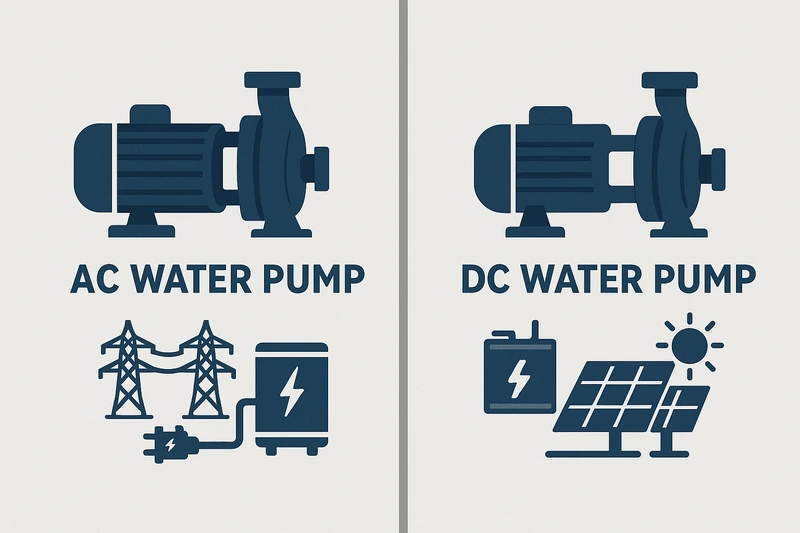
In this guide, we’ll compare AC and DC water pumps in simple terms—how they work, where each one makes sense, and how to choose the right option for your project.
Common questions we’ll answer:
- What’s the main difference between AC and DC water pumps?
AC pumps run on grid or generator power, while DC pumps run on direct current—often from solar panels or batteries. - Which one is better for solar pumping?
DC pumps are usually more efficient for off-grid solar setups because they can run without an inverter. - Which one is stronger for heavy-duty work?
AC pumps are commonly used for large, constant-demand systems. - Which one is cheaper overall?
DC pumps often reduce solar system costs and energy waste. AC pumps can be cheaper upfront if grid power is already available. - How do I decide quickly?
If your site is off-grid or solar-first → choose DC. If you rely on stable grid power for nonstop pumping → choose AC.
What Are AC vs. DC Water Pumps?
An AC water pump uses alternating current—the electricity you normally get from the power grid or a generator.
A DC water pump uses direct current—the type of electricity produced by solar panels and stored in batteries.
A very simple way to remember it:
- AC = runs from the grid or generator.
- DC = runs directly from solar or battery power.
How Do AC Water Pumps Work and Where Are They Best?
AC pumps are the traditional and most widely used type. Since most homes, farms, and industrial sites already have AC electricity, these pumps are easy to install and power.
AC pumps are a great choice when:
- You have reliable grid power or a generator.
- You need continuous pumping, including at night.
- Your application needs high flow or high head for long periods, such as large irrigation or industrial water transfer.
One key limitation:
If you want to power an AC pump using solar, you usually need an inverter to convert DC solar electricity into AC. That adds cost and causes some energy loss.
How Do DC Water Pumps Work and Why Are They Ideal for Solar?
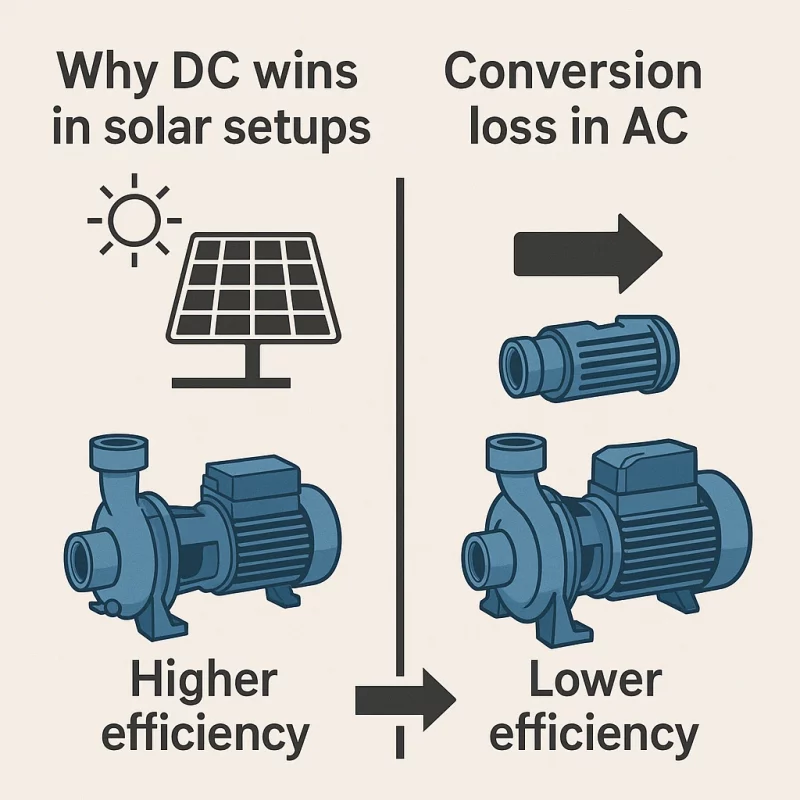
DC pumps run directly on DC power. In solar systems, that means they can connect straight to solar panels or batteries.
DC pumps are usually the best option when:
- Your location is off-grid or power is unstable.
- You want maximum efficiency from solar panels.
- You need water for livestock, gardens, remote homes, or small-to-medium irrigation systems.
Why DC wins in solar setups
Because DC pumps don’t require DC-to-AC conversion, the system loses less energy. This usually means better performance from the same solar array size.
AC vs. DC Water Pumps: What Are The Key Differences?
| Feature | AC Water Pump | DC Water Pump |
| Power source | Grid / generator AC | Solar panels / batteries / DC |
| Solar setup | Needs inverter | Usually no inverter needed |
| Efficiency in solar | Lower due to conversion loss | Higher, direct solar use |
| Best for | Constant, heavy-duty jobs | Off-grid, solar-first systems |
| System complexity | Simple with grid power | Simple with solar power |
| Typical use cases | Large irrigation, industry, homes with grid | Remote irrigation, livestock, solar water supply |
Which One Should You Choose for Your Project?
When Should You Choose an AC Water Pump?
Choose AC if:
- You already have stable AC electricity on site.
- Your pump needs to run day and night, regardless of sunlight.
- You’re working on large-scale applications that demand continuous high power.
When Should You Choose a DC Water Pump?
Choose DC if:
- Your power source is mainly solar or batteries.
- Your site is remote or off-grid.
- You want a simpler system with lower energy waste.
Which DC Water Pumps Are Popular Choices?
Here are several DC models that are commonly used for solar and off-grid water pumping, covering a range of power levels and outlet sizes:
- GPT – GP-100 DC Water Pump – 3HP – 4″
- GPT – GPDC-750-1 DC Water Pump – 1HP – 1″
- GPT – GPDC-2200-4 DC Water Pump – 3HP – 4″
- GPT – GPDC-1500-3 DC Water Pump – 2HP – 3″
- GPT – GP-80 DC Water Pump – 2HP – 3″
- GPT – GP-50 DC Water Pump – 1.5HP – 2″
For more models see our DC water pumps.
These pumps are designed for direct DC operation, making them efficient and practical for solar-driven applications.
10 Frequently Asked Questions (FAQ)
- Is a DC pump always better than an AC pump?
Not always. DC pumps are better for solar and off-grid efficiency. AC pumps are better for constant heavy-duty jobs on the grid. - Can I run an AC pump on solar power?
Yes, but you usually need an inverter to convert DC solar power to AC. - Why are DC pumps more efficient for solar setups?
They use solar power directly, avoiding conversion losses. - Do DC pumps work at night?
Only if your system includes batteries or hybrid control. Without stored energy, they stop when sunlight is gone. - Which lasts longer, AC or DC pumps?
Lifespan depends more on pump quality, water conditions, and maintenance than on AC or DC power. - Are DC pumps safe for remote installations?
Yes. Many DC systems use lower voltage, which is often safer for remote or wet environments. - What is the main extra cost of using AC pumps with solar?
The inverter, plus potentially extra solar panels to cover conversion losses. - What applications suit DC pumps best?
Livestock watering, gardens, remote farms, off-grid homes, and solar irrigation. - Can DC pumps handle large irrigation?
Some high-power DC models can, but for very large nonstop irrigation, AC or hybrid setups may be more practical. - How do I size a pump correctly?
Start with your required flow rate and total head, then choose AC or DC based on your available power source.
Final Takeaway
The choice between AC vs. DC water pumps is not about which is better overall—it’s about which is better for your conditions.
- If your system is solar-based or off-grid, a DC pump usually gives you higher efficiency and simpler setup.
- If you need continuous high-power pumping with reliable grid electricity, an AC pump is often the smarter fit.
Pick the power type that matches your energy source, and your pump will perform better, last longer, and cost less to run.