
Blog
12V vs. 24V vs. 48V DC Pumps: Choosing the Right Voltage


This guide explains the real difference between 12V, 24V, and 48V DC pumps in a simple way. We’ll focus on what voltage means for performance, solar setups, wiring, cost, and which one fits your project.
Questions users usually ask (answered fast):
- Does higher voltage mean a stronger DC pump?
Not automatically, but higher voltage systems usually handle bigger pumps more efficiently. - Which voltage is best for solar water pumping?
24V and 48V are typically better for medium to large solar systems; 12V is best for small setups. - What changes when voltage changes?
Mainly current (amps) and cable requirements. Higher voltage = lower amps for the same power. - Which one is easiest to install?
12V is the simplest for short distances; 24V/48V are better when the pump is far from the power source. - How do I choose quickly?
Small/light duty + short cable → 12V
Medium duty + normal distances → 24V
High power + long distances → 48V
What Does Voltage Mean in 12V vs 24V vs 48V DC Pumps?
Voltage is basically the “pressure” that pushes electricity through the system.
For DC pumps, voltage affects how much current (amps) the pump pulls to produce power.
A simple rule:
- Higher voltage = lower amps for the same power.
- Lower amps = less heat, less energy loss, and thinner/cheaper cables.
That’s why voltage choice matters a lot in solar and off-grid pumping.
How Is Power Different in 12V vs 24V vs 48V DC Pumps?
Power is what actually runs your pump. In DC systems:
Power (Watts) = Voltage (V) × Current (A)
So if two pumps need the same power:
- A 12V pump needs more amps
- A 48V pump needs fewer amps
Example (same 480W pump):
- 12V system → 480 ÷ 12 = 40A
- 24V system → 480 ÷ 24 = 20A
- 48V system → 480 ÷ 48 = 10A
Lower current is easier on wiring and controllers, especially for solar.
What Are the Practical Differences in 12V vs 24V vs 48V DC Pumps?
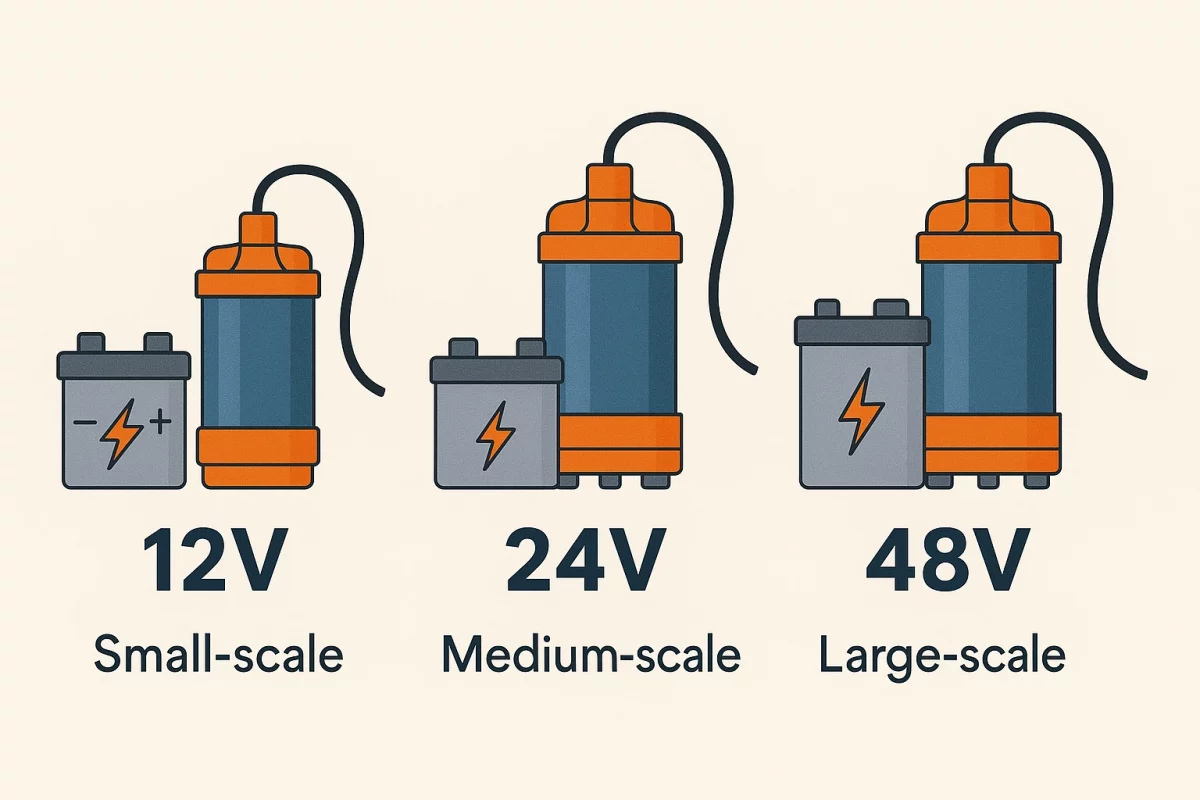
Cable Distance and Voltage Drop in 12V vs 24V vs 48V DC Pumps
When you send power through cables, some voltage is lost on the way.
This is called voltage drop, and it’s the #1 reason people move to higher voltage.
- 12V systems drop voltage quickly over distance → best for short runs.
- 24V systems handle distance better.
- 48V systems are the best option for long cable runs and high power.
Efficiency and System Size in 12V vs 24V vs 48V DC Pumps
- 12V is great for small pumps and light tasks.
- 24V is the most common “sweet spot” for solar pumping.
- 48V shines when you need serious flow/head or a large PV array.
12V vs 24V vs 48V DC Pumps Comparison Table
| Feature | 12V DC Pumps | 24V DC Pumps | 48V DC Pumps |
| Best system size | Small | Medium | Large / heavy duty |
| Current (amps) needed | Highest | Medium | Lowest |
| Cable length tolerance | Short | Medium | Long |
| Wiring cost | Can be high (thick wire) | Moderate | Often lower per watt |
| Solar compatibility | Small PV + battery | Most solar setups | High-power PV arrays |
| Typical use | RVs, small tanks, gardens | Farms, homes, irrigation | Deep wells, big irrigation, long-distance setups |
Which Voltage Should You Choose for Your DC Pump Project?
When Should You Choose a 12V DC Pump?
Choose 12V if:
- Your pump is small and close to the battery/solar source.
- You’re watering a garden, small tank, or light domestic use.
- You want a simple and low-cost setup.
Typical use cases:
small irrigation, water transfer, cabins, RVs, livestock troughs near the power source.
When Should You Choose a 24V DC Pump?
Choose 24V if:
- You have a medium solar system.
- The pump is a bit farther from the panels/batteries.
- You want a balance of efficiency and simplicity.
Typical use cases:
standard solar irrigation, farm supply lines, household off-grid water.
When Should You Choose a 48V DC Pump?
Choose 48V if:
- You need higher power, higher head, or high flow.
- Your pump sits far from the power source.
- You’re building a larger PV array and want maximum efficiency.
Typical use cases:
deep well pumping, large irrigation, high-demand off-grid systems.
What DC Pumps Do We Recommend at SpringPump?
If your project is solar or off-grid, exploring our DC pumps category is the fastest way to compare models by power and outlet size.
Some popular choices include:
- GPT – GP-100 DC Water Pump – 3HP – 4″
A high-power option suitable for larger solar systems—often paired with higher voltages for better efficiency. - GPT – GPDC-750-1 DC Water Pump – 1HP – 1″
Great for small to mid tasks; can fit well in 12V or 24V systems depending on distance. - GPT – GPDC-2200-4 DC Water Pump – 3HP – 4″
Strong performance for demanding jobs—commonly used with 48V setups in bigger solar arrays. - GPT – GPDC-1500-3 DC Water Pump – 2HP – 3″
Balanced choice for farming and irrigation, especially in 24V systems. - GPT – GP-80 DC Water Pump – 2HP – 3″
Reliable mid-power pump for off-grid water delivery. - GPT – GP-50 DC Water Pump – 1.5HP – 2″
A practical option for lighter solar pumping, often used in compact systems.
10 Frequently Asked Questions (FAQ)
- Is a 48V DC pump always better than a 12V one?
Not always. 48V is better for high power and long distances. For small nearby jobs, 12V can be the smarter choice. - Can I run a 24V pump on a 12V battery?
Not directly. You’d need a converter or a proper 24V battery bank. - Which voltage is most common in solar DC pumps?
24V is the most common because it balances efficiency and system cost. - Does higher voltage reduce electricity cost?
It reduces losses in wiring and conversion, so the system wastes less energy. - What happens if voltage drop is too high?
Pumps may run weakly, overheat, or shut down. That’s why distance matters. - Can I switch from 12V to 24V later?
Yes, but you may need to change batteries, controller, and sometimes the pump. - Do higher-voltage pumps last longer?
Voltage alone doesn’t decide lifespan, but lower current can reduce heat stress on the system. - What voltage is best for deep wells?
Usually 48V, because deep wells need higher power and often long cable runs. - Do I need an inverter for DC pumps?
No. DC pumps run directly on solar/battery DC, which is why they’re efficient off-grid. - How do I choose voltage if I don’t know my pump size yet?
Start with your required head and flow, then match a pump. After that, pick voltage based on power level and distance.
Final Takeaway
The voltage choice in 12V vs 24V vs 48V DC pumps is really about project scale and distance:
- 12V → small pump, short cables, simple setup
- 24V → the all-around best option for most solar farms and homes
- 48V → high power, long distances, maximum efficiency
If you share your head, flow, and distance from panels to pump, I can suggest the most suitable voltage and model.